Production
Dune filming locations: the real deserts behind Arrakis
Arrakis is four real places and one backlot. Knowing which part came from where explains most of the choices the production made.
Jordan did most of the work
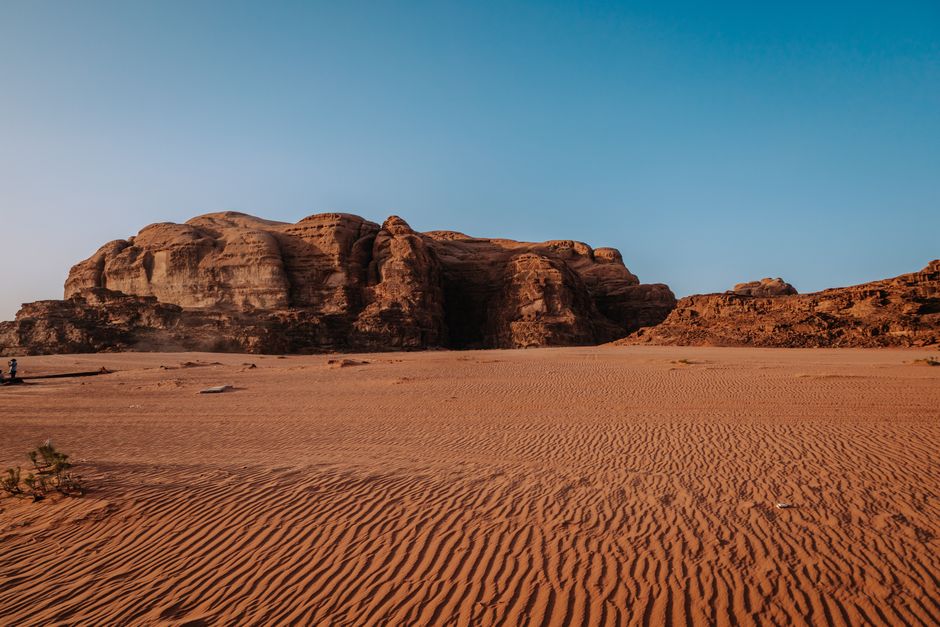
The majority of the desert in both films is Wadi Rum in southern Jordan — the Valley of the Moon, a UNESCO World Heritage site, and for twenty years the default answer whenever a production needs a planet that is not Earth. Part Two added Wadi Araba, further west.
What Wadi Rum offers is not sand. It is sandstone: vertical rock rising straight out of flat ground, so a camera can hold both the scale of a cliff and an unbroken horizon in one frame without a single set piece. That geology is also why Jordan keeps getting the work ahead of larger deserts.
Abu Dhabi supplied what Jordan cannot
For the open dune sea the production moved to the Liwa Oasis on the edge of the Empty Quarter, where the crew spent eleven days. The draw there is size: individual dunes rise past a hundred and fifty metres, and a slope that tall reads on screen as terrain rather than as scenery.
It is also the harder of the two units. Soft sand means every vehicle, generator and camera cart is a logistics problem, shade does not exist, and the usable window at either end of the day is short.
Everything that was not desert
Caladan, the Atreides home world, is Stadlandet on the Norwegian coast — cold, grey and wet, chosen precisely because it is the visual opposite of Arrakis. Interiors and the large action sequences were built at Origo Studios in Budapest, which carried both films. Part Two added Altivole in the Italian Veneto for the Corrino material.
The pattern is worth noticing: two desert units for what only a real landscape can give, and a stage for everything that can be controlled. Almost no production can afford to reverse that order.
What it takes to shoot there
Desert locations in the region are permitted, not open. A shoot of this kind needs a national filming approval, a consent from whoever controls the specific site, and a local notification — three separate layers, each wanting to see the one above it. Protected landscapes like Wadi Rum sit in the slower queue, and drone work is a distinct application that a filming approval does not cover. Which permit is which, and how long each takes, is set out in location permits.
The cost that catches people is not the fee. It is the day: crew, kit and a location already paid for while a document arrives late. Budget the schedule risk rather than the paperwork, and keep it in pre-production — where the money to cover it comes from is the subject of first money.